Integrated Master’s Degrees Explained (MSci, MEng, MPhys)
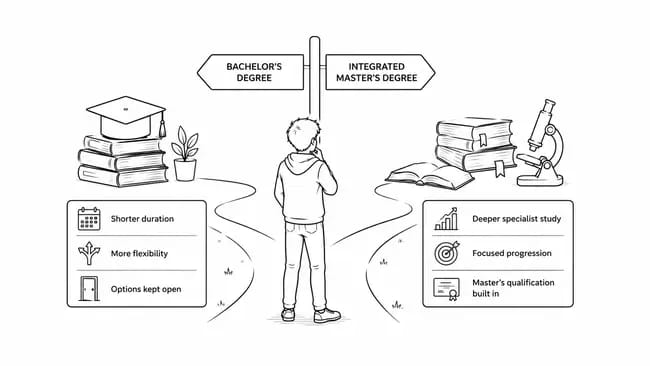
An integrated master’s is a longer undergraduate-entry degree with advanced study built in. It can suit students who want deeper specialist study or need it for a professional route, but it is a bigger commitment than a standard bachelor’s degree and should not be chosen just because it sounds more impressive.
An integrated master’s degree can look confusing because it has “master’s” in the title but is chosen through UCAS as an undergraduate course.
You do not normally apply for a bachelor’s degree first and then apply separately for the master’s year. Instead, you enter one longer programme that combines undergraduate study with more advanced work in the later years.
Common titles include MEng for engineering, MSci for science subjects, MPhys for physics, MChem for chemistry and MMath for mathematics. The exact title depends on the subject and university, so read the course structure rather than relying on the label.
If you are still comparing course formats, Types of University Degrees Explained (BA, BSc, Joint Honours & More) gives a wider overview of common UK degree labels.
How integrated master’s courses work
An integrated master’s combines undergraduate and master’s-level study into one course.
It usually lasts four years in England, Wales and Northern Ireland, or five years in Scotland. The earlier years cover the core undergraduate subject. Later years move into more advanced modules, specialist study, research, design work, laboratory work or a substantial project.
This route is common in subjects where depth and technical progression matter. Engineering is the clearest example, but integrated master’s routes also appear in physics, chemistry, mathematics and other sciences.
The course usually becomes more demanding as you progress. The final stage is not simply an extra year of the same undergraduate work. It is meant to take you further into the subject.
Integrated master’s vs bachelor’s degree
The main difference is duration and level.
A standard bachelor’s degree, such as a BSc or BA, gives you undergraduate-level study. For many careers and postgraduate options, that is enough.
An integrated master’s takes you further within one continuous programme. You stay on the same route for longer and complete more advanced study before graduating. It is more structured than doing a bachelor’s degree first and deciding later whether to apply for a separate master’s.
A separate master’s gives you more flexibility after your first degree. You can change university, adjust your specialism, take time out, or decide that postgraduate study is not necessary.
The longer integrated route only makes sense if the extra depth is useful to you and the subject is one you want to keep studying.
Need help choosing the right university course?
This page covers one part of the decision. For the full route through comparing subjects, reading course pages, checking modules and making a confident shortlist, use the main course choice guide.
Go to the course choice guide →How it differs from doing a master’s later
The difference between an integrated master’s and a separate postgraduate master’s is mainly about timing.
With an integrated master’s, you commit earlier. You choose the longer route before you have experienced university-level study. If the course suits you, that can be efficient: you move through one planned programme and build towards advanced work without a separate postgraduate application.
With a separate master’s, you decide later. You complete a bachelor’s degree first, then choose whether to continue, where to study, and what specialism to pursue. That can give you more time to understand your strengths and change direction.
The integrated route gives you continuity; the separate route leaves more room to decide later. Neither is automatically stronger. The better route depends on how certain you are about the subject and how much room you want to reconsider later.
Check progression rules
Do not assume that starting an integrated master’s guarantees that you will complete the final master’s-level stage.
Some universities require students to achieve certain grades during the course to continue on the integrated route. Others may allow movement between the bachelor’s and integrated master’s version, depending on performance, places and course rules.
Check whether progression to the final stage is automatic, whether you need specific marks to continue, whether you can transfer between the bachelor’s and integrated master’s routes, and whether funding, fees or course length change if you switch.
These details matter because the integrated route is a longer commitment. The route itself matters more than the qualification label.
If you are comparing entry rules and progression conditions, How Important Are Entry Requirements When Choosing a Degree? explains how to read admissions requirements as part of a wider course decision.
Check what the advanced year actually contains
The later stage is where an integrated master’s should earn its place.
Look beyond the title and read the module structure. The final year might include advanced technical modules, a research project, design work, laboratory work, group projects, professional preparation or a dissertation.
Look at what changes in the final year, which modules are master’s-level, and whether there is a major project or research element. The advanced content should interest you and support the kind of subject depth you want. If a standard bachelor’s degree would give you enough, the integrated route may not add much value.
If the final year looks like the part of the course you most want, the integrated route may make sense. If it feels like extra commitment without clear value, think carefully.
How to Read University Course Modules (What You’ll Actually Study) can help you judge whether the course structure genuinely matches what you want to study.
Who an integrated master’s may suit
An integrated master’s may suit you if you already have strong interest in the subject and want to study it in greater depth.
It can be a good fit if you are confident about the subject area, comfortable with sustained academic challenge, and interested in the later modules or project. It may also make sense where the subject benefits from deeper technical preparation, or where the route supports a professional or specialist direction you already know you want.
This does not mean you need your whole career planned. It does mean the subject itself needs to matter enough for a longer, more demanding route.
Be more cautious if you are still unsure about the subject. If you want time to explore, change direction, or decide later whether postgraduate study is necessary, a standard bachelor’s degree may give you more room. You could still apply for a separate master’s after graduation if deeper study becomes the right next step.
Prestige is not a good enough reason on its own. MEng, MSci or MPhys can sound impressive, but the label is not enough. You need to want the course structure, not just the qualification title.
Also think about cost and time. A longer course usually means another year of study, fees and living costs. That may be worthwhile, but it should be part of the decision.
Before choosing an integrated master’s
Before choosing an integrated master’s, check whether you genuinely want to study the subject for longer, what the final master’s-level stage includes, and whether progression is automatic or depends on grades. You should also know whether you can move between the bachelor’s and integrated master’s routes later.
The main comparison is not just bachelor’s versus integrated master’s. It is also integrated master’s versus doing a separate master’s later. A separate master’s may give you more flexibility after your first degree, especially if your interests change or you want to specialise elsewhere.
An integrated master’s is worth choosing when the extra year has a clear purpose: deeper study, stronger preparation, or a route you already know you want.
Continue reading
Main course choice guide →
Return to the full guide for comparing subjects, course structures, modules, entry requirements and future options before finalising your choices.

How Flexible Is Your Degree Choice for Future Careers?Your degree can shape your first step after university, but it rarely fixes your whole career. Flexibility depends on whether the subject leads to a fixed route, a broad graduate field, or skills and experience you can carry into different work.

Which Degrees Lead to the Most Career Options?Some degrees keep more routes open than others, but broad is not automatically better. The stronger choice is a course that builds transferable skills, gives you evidence for future applications, and still suits the way you want to study.

Broad vs Specialist Degrees: Which Should You Choose?Broad degrees give you room to explore, while specialist degrees give you depth earlier. The right choice depends on how certain you are, how much structure you want, and whether the course gives you enough focus without narrowing too soon.
Writing your personal statement →
Once you have a clearer course direction, use the personal statement guide to plan, structure and refine your UCAS answers with stronger academic focus.