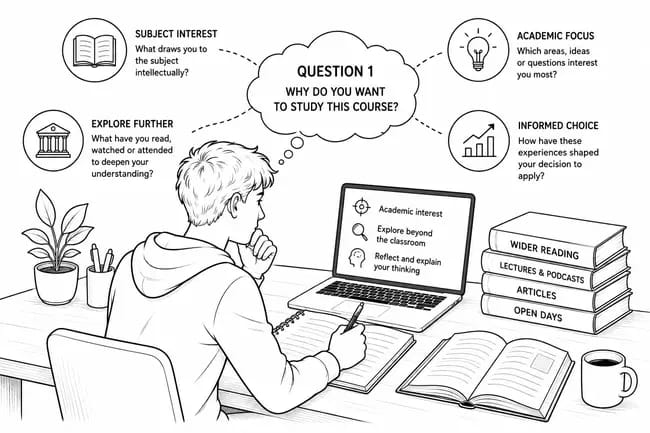
Question 1 asks for clear academic motivation: what interests you about the subject, how you have explored it, and why the course is an informed choice.
What UCAS personal statement question 1 is really asking
The first UCAS personal statement question asks why you want to study your chosen course.
That can seem straightforward: you've always loved the subject, you found it fascinating at school, or you've felt passionate about it from a young age; but these statements don't actually say much. Admissions staff are not looking for intensity of feeling. They're looking for evidence that you understand what you are applying to study, that you have engaged with it beyond the classroom, and that you can explain your academic motivation in a clear and focused way.
A strong answer shows three things. First, you have thought seriously about the subject itself. Second, your interest is based on specific experiences, ideas, or questions rather than vague enthusiasm. Third, you can express that interest in a way that sounds reflective and credible.
The opening part of your statement sets the direction for everything that follows. If your first answer is general or unfocused, the rest of the statement will also feel disconnected.
What admissions teams are assessing
When universities read this section, they are trying to understand how well your reasons fit the course. They want to see whether your interest is academic, whether you have looked beyond the basic syllabus, and whether you can explain your thinking with some precision.
In practice, that means your answer should help a reader see:
- what draws you to the subject intellectually
- which parts of the course or discipline interest you most
- what you have done to explore that interest further
- how those experiences confirmed or developed your decision to apply
You don't need advanced research experience or unusual achievements. A thoughtful explanation of one book, one lecture, one project, one article, or one open day conversation can be more effective than a long list of activities. What matters is the quality of reflection.
Official advice from admissions teams also points in this direction. For example, the University of Manchester emphasises the value of showing why you are interested in the course and what you have done to explore that interest.
What belongs in your answer
A strong response to UCAS personal statement question 1 includes a combination of subject curiosity, evidence of exploration, and a focused explanation of your academic interests.
Subject curiosity
Start with what genuinely interests you about the course. This should go beyond saying that the subject is important, enjoyable, or useful. Try to identify a particular area, question, or problem that has held your attention.
For example, a Business applicant might be interested in why some companies keep customer loyalty while others lose it quickly. That could lead into questions about branding, pricing, consumer behaviour or long-term strategy. The more specific your focus, the more convincing your answer becomes.
Wider reading and academic exploration
If you have done any reading, listening, watching, or attending that helped you understand the subject more deeply, this is usually relevant. Don't name resources for the sake of sounding academic. Instead, explain what you engaged with and what it helped you notice, question, or understand.
Useful material might include:
- books or articles related to the subject
- podcasts, lectures, or documentaries
- essay competitions or webinars
- museum visits, exhibitions, or public talks
- university taster sessions or open day discussions
Super-curricular activity
Super-curricular activities are activities that deepen your understanding of the subject itself. They are different from extracurricular activities such as sport, music, or volunteering unless those activities have a direct academic link to your course choice.
For this first question, super-curricular evidence is especially useful because it shows that your interest has been tested and developed. If you completed an online course, followed a relevant public lecture series, analysed a case study, or explored subject-related material independently, you can use that to support your answer.
Don't just report the activity. Explain what changed as a result of it. An online course, lecture, case study or independent project becomes useful when you show how it sharpened your understanding, challenged an assumption, or helped you see which part of the subject interests you most. Those details make your motivation believable.
Specific academic interests
You don't need to map out your entire degree. However, it helps to show some awareness of the field you are entering. This might mean referring to a topic you hope to study further, a question you want to explore, or a method you find especially interesting.
That kind of specificity reassures admissions tutors that your application is based on more than broad approval of a school subject. It suggests that you are thinking in subject terms already.
What to avoid
Many weak answers share the same problems. They are not necessarily badly written, but they do not give the reader enough evidence.
Clichés
Phrases such as these often weaken the opening:
- I have always been passionate about this subject
- Ever since I was young, I have wanted to study this course
- I find this subject fascinating
- I know this degree is perfect for me
These statements are common because they feel safe. The problem is that almost any applicant could say them. Without explanation, they do not show why your interest developed or what it is based on.
Unsupported claims
Saying you are dedicated, curious, analytical, or committed does not prove it. You need to show the reader how your actions support the claim. A short, specific example is usually more persuasive than a strong adjective.
Overly personal stories that do not lead back to the subject
A brief personal starting point can work if it clearly leads into academic motivation. However, long stories about childhood experiences, family background, or general life events can take up valuable space without helping the reader understand why you want to study the course.
Generic reasons that could fit any subject
Statements about wanting to help people, make a difference, solve problems, or gain useful skills are often too broad on their own. They may be relevant, but they need to be linked back to the discipline. Why this subject in particular. What aspect of the field gives those ambitions substance.
Weak and strong examples: what's the difference?
The difference between a weak and a strong answer is usually about moving from assertion to evidence, and then reflecting on that evidence.
Example 1: broad enthusiasm
Weak version:
I want to study economics because I have always found it fascinating and I am passionate about understanding how the world works.
Why it is weak:
This tells the reader almost nothing. The subject is named, but no particular idea, issue, or experience is mentioned. The claim of passion is unsupported.
Stronger version:
My interest in economics developed after comparing news coverage of rising interest rates with what I had learned about inflation in class. I looked at Bank of England explainers on monetary policy and began to understand why a single interest rate decision can affect borrowers, savers and renters differently. I wanted to study Economics because it gives me the tools to analyse those trade-offs more rigorously: not just what a policy is meant to achieve, but who it affects, what evidence supports it, and what limits policymakers face.
Why it is stronger:
This version works better for Question 1 because it gives a specific academic interest, shows an action the student took to explore it, reflects on what that exploration helped them understand, and links the whole point back to their motivation for studying Economics. It doesn’t just claim enthusiasm. It shows how the interest developed.
Example 2: listing an activity without reflection
Weak version:
I attended a law summer school and read books about criminal law, which made me certain that law is the right course for me.
Why it is weak:
The activities are named, but the reader does not learn what the applicant actually gained from them.
Stronger version:
Attending a law summer school introduced me to the way legal reasoning depends on close interpretation and careful argument. I then read a chapter from Jonathan Herring’s Criminal Law on consent, which showed me how legal decisions can turn on precise definitions, evidence and responsibility rather than simple ideas of guilt or innocence. Together, these experiences made me more interested in studying how legal systems balance principle with practical judgment.
Why it is stronger:
This version works because the applicant doesn’t just name the activity. They identify a specific text, explain what it helped them understand about Law, and link that insight back to their motivation for studying the subject. The interest has been tested and developed, not simply asserted.
Example 3: personal motivation without academic focus
Weak version:
I want to study psychology because I enjoy learning about people and I want to help others in the future.
Why it is weak:
This could apply to many different subjects and professions. It does not show engagement with psychology as an academic discipline.
Stronger version:
Psychology interests me because it combines theories of behaviour with research methods that test those ideas systematically. After completing an online research methods taster, I tried a simple Stroop task and was struck by how a small experimental design could reveal the gap between automatic and controlled attention. That made me want to study Psychology further because it showed me how the subject turns everyday assumptions about the mind into questions that can be tested with evidence.
Why it is stronger:
The applicant names a specific area of Psychology, describes an action they took, reflects on what it helped them understand, and links that insight back to their motivation for studying the subject. The answer moves beyond wanting to “help people” and shows interest in Psychology as an academic discipline.
A simple structure you can use
If you are unsure how to organise your answer, a clear structure can help. One effective approach is:
- Identify the subject interest.
- Give evidence of how you explored it.
- Explain what that experience showed you.
- Link this back to why you want to study the course.
In practice, that might look like this in paragraph form:
You begin with a specific academic interest or question. You then refer to one or two relevant super-curricular experiences, such as reading, lectures, projects, or discussions. After that, you explain what those experiences helped you understand. Finally, you show how that made the course a serious and informed choice.
This structure keeps your answer focused. It also helps you avoid drifting into unsupported claims.
How to write about wider reading and super-curriculars well
Many applicants include wider reading, but not all use it effectively. The strongest approach is usually selective. One or two thoughtful examples are more useful than a long catalogue.
When you mention wider reading or another super-curricular activity, try to answer these questions:
- What did you engage with?
- What idea, argument, or issue stood out?
- How did it deepen or refine your understanding of the subject?
- Why did it make you more interested in studying the course?
For example, saying you read a book about politics is only the starting point. Instead, explain which argument interested you and how it changed your thinking. The same principle applies to lectures, podcasts, online courses, or open day conversations.
How question 1 connects to questions 2 and 3
The three UCAS questions should work together, but they don’t ask for the same evidence. Question 1 explains your academic motivation: why this course or subject interests you, and why that interest is serious enough for university study.
Question 2 then supports that motivation through your formal studies and qualifications. This is where you can discuss subjects, coursework, projects, investigations, practical work, essays or other academic tasks completed as part of school or college. If you want to plan that section carefully, see our guide on how to answer UCAS personal statement question 2.
Question 3 covers preparation outside education. This is where super-curricular activity belongs: wider reading, lectures, online courses, independent projects, competitions, work experience, volunteering or responsibilities that helped you prepare for the course. For a fuller breakdown, read how to answer UCAS personal statement question 3.
A focused statement keeps the three answers connected. If Question 1 explains an interest in the analytical side of a subject, Question 2 can show how formal study developed the skills behind that interest, while Question 3 can show what you did beyond school or college to test, deepen or apply it. Each answer has its own job, but all three should build the same case for studying the course.
A drafting method that helps you sound specific
If your first draft sounds generic, go back to the evidence before trying to improve the sentences. Make notes under three headings:
- what genuinely interests you in the subject
- what you have done to explore that interest
- what those experiences helped you understand
Then look for a thread. A medicine applicant, for example, might find that work experience, wider reading and a school project all point towards the same interest in ethical decision-making. That thread can become the backbone of the answer.
This also keeps the writing honest. You don’t need to claim lifelong certainty. You need to show that your decision is thoughtful, informed and grounded in real engagement.
A short checklist before you finalise your answer
Before you complete this section, check whether your response does the following:
- names a clear academic reason for choosing the course
- includes specific evidence rather than general enthusiasm
- explains what you learned from reading or super-curricular activity
- avoids clichés and unsupported claims
- links naturally to the themes you develop later in the statement
If the answer to several of these points is no, revise for clarity rather than trying to sound more impressive. Precision is usually more effective than intensity.
Final thoughts
UCAS personal statement question 1 is not asking you to prove that you care more than anyone else. It is asking you to show that your interest in the course is real, informed, and academically grounded.
Focus on what draws you to the subject, what you have done to explore it, and what those experiences revealed. If you can show that clearly, your opening will give the rest of the statement a much stronger foundation.