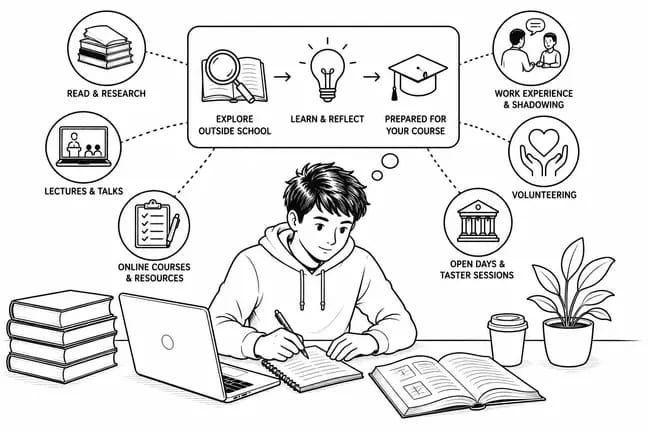
Question 3 asks what you have done beyond formal education to prepare for the course, what it helped you understand, and how it strengthens your readiness.
What UCAS personal statement question 3 is really asking
UCAS personal statement question 3 asks what you have done outside formal education to prepare for your chosen course. You need to show subject preparation beyond school or college, and explain how that preparation supports your readiness to study the course.
Admissions teams are looking for relevant activity such as super-curricular exploration, independent reading, short courses, work shadowing, volunteering, projects, competitions, talks, taster sessions, or other experiences connected to your subject. The length of the activity and how impressive it sounds matters far less than whether it helped you understand the subject more clearly and whether you can reflect on that learning.
If you have not yet read about how UCAS expects applicants to discuss their academic preparation, it may help to look first at How to Answer UCAS Personal Statement Question 2, because question 2 and question 3 work together.
The difference between super-curricular and extracurricular activity
Super-curricular activity takes your interest in the subject beyond the classroom. It shows academic engagement with the course itself, but not through your school-work. This may include independent reading, a subject lecture, a relevant podcast, a short online course, an independent project, a museum or archive visit with a clear academic purpose, a competition, or work experience that gave you insight into the field.
Extracurricular activity sits outside your academic subject. It may still show useful qualities, but it does not automatically show course preparation. Sport, music, student committees, paid work, caring responsibilities and general volunteering can all be valuable, but they need a clear link to the course if you include them in question 3.
For question 3, super-curricular content is stronger because it connects your preparation directly to the course. Admissions tutors want to see evidence that you understand what the subject involves, have explored it independently, and can sustain an interest beyond lessons.
Extracurricular activities can still be useful when they support your academic case, but the link needs to be specific. Debating or Model United Nations, for example, can strengthen a Law application if you explain how it developed your ability to build arguments, respond to evidence and think critically. The activity belongs in Question 3 because it helps show preparation for the kind of reasoning the course will require.
The activity can be ordinary, provided the connection to the course is clear. It should help the reader understand how your preparation has developed.
Why relevance matters more than variety
A common mistake is to use question 3 as a list of everything you have done outside school or college. That weakens the answer because it includes irrelevant material, and leaves little room for reflection.
A more selective answer is stronger. Choose examples that genuinely connect to the course and give yourself enough space to explain them. Your aim is to show a pattern of relevant preparation, not to prove that you have been involved in as many activities as possible.
A useful example should show what you did, what you learned or noticed, and why that matters for the course. Without that final connection, the answer becomes descriptive rather than analytical.
If an activity could appear unchanged in an application for almost any subject, the link is too weak. Strengthen the connection to the course or choose a better example.
What kinds of outside preparation can work well
Outside preparation works best when it shows that your interest has moved beyond normal lessons. That might mean exploring the subject independently, testing it in a practical setting, or taking on responsibility that helps you understand the course or profession more clearly.
Independent reading and research
Reading beyond your syllabus is strong evidence of academic motivation when you can explain how it developed your thinking. This could include books, journal articles, essays, reports, or specialist publications connected to your course.
Do not name a difficult text just to make the application sound stronger. The reader needs to see what you understood from it and why it mattered. A Philosophy applicant who reads part of Mill’s On Liberty, for example, should explain the idea they took from it, such as the tension between individual freedom and harm to others, and how that shaped their interest in political philosophy.
Work experience and observation
Work experience is valuable when it gives insight into the realities of the subject or profession. This is especially relevant for vocational courses such as Medicine, Nursing, Teaching, Social Work, or Architecture, but it can also help in many other subjects.
Strong work experience answers focus on observation and reflection. Instead of listing duties, explain what you noticed, what challenged your assumptions, and what this helped you understand about the course or profession. Admissions teams are less interested in where you were placed than in what you learnt from being there.
Volunteering
Volunteering can support an application when it develops relevant understanding. For example, volunteering in a care home may support a Nursing application if you reflect on communication, dignity, patience, and the practical responsibility involved in supporting people with different needs.
Volunteering should show something about your understanding of the subject, the people involved, or the responsibilities linked to the course. Character matters, but it needs to be connected to learning and course preparation.
Personal projects and independent study
Independent projects are highly effective because they show initiative. These might include building an app, writing an essay outside class, carrying out a science investigation, creating a portfolio, learning coding skills, entering a competition, or analysing data on a topic that interests you.
Projects can be particularly useful if you have had limited access to formal work experience. They show that you found a way to explore the subject for yourself and learned from the process.
Open days, lectures, and taster events
Simply attending an open day is weak evidence, but these experiences become useful when you engage with them actively. Asking focused questions, comparing course structures, or gaining a clearer understanding of how the subject is taught gives you something stronger to discuss.
UCAS offers advice on preparing for a university open day, which can help applicants get useful insight from these visits rather than treating them as passive events.
How to turn an activity into a strong answer
A strong answer explains what you understood from the experience and why that matters for the course, rather than only naming the activity.
If you helped run social media for a school society or local group, the activity itself only gives the reader limited information. A stronger answer would explain how you learned to think about audience, tone, timing and engagement. For Marketing, that kind of reflection shows a clearer understanding of how communication choices affect how people respond, and gives the experience a direct connection to the course.
This is the difference between description and reflection. Description tells the reader what happened. Reflection explains what the experience helped you understand.
Weak and stronger examples
Example 1: Independent subject exploration
Weak:
I completed an online cyber security challenge because I enjoy technology and wanted to learn more about the subject.
Stronger:
In a beginner capture-the-flag challenge, I worked through a web security task where a login form accepted unsafe input. I tested different entries, traced why the check failed, and read the explanation afterwards to understand the vulnerability. That made me more interested in Cyber Security because it showed how small design choices can create wider risks, and why secure systems depend on testing as well as coding.
Example 2: Work experience
Weak:
I completed work experience at a law firm, where I learned a lot about being a lawyer.
Stronger:
During a work experience task at a local law firm, I read a short client scenario and had to decide which facts were relevant before drafting a brief note. I found the hardest part was separating what sounded persuasive from what could actually be supported by evidence. That made Law appeal to me because it showed how legal reasoning depends on close reading, judgement and disciplined argument.
Why it works:
This moves beyond the setting. The applicant explains the task, reflects on the difficulty, and links the experience to the kind of thinking Law requires.
Example 3: Volunteering
Weak:
I helped at a coding club, which improved my communication skills and showed that I am responsible.
Stronger:
While helping at a local coding club, I worked with younger pupils who kept getting stuck on small errors in Scratch projects. Explaining the problems forced me to break the logic into smaller steps and think about how someone else understands a sequence of instructions. It strengthened my interest in Computer Science because it showed that programming is not just writing code; it also involves debugging, clarity and problem-solving.
Why it works:
The volunteering is not treated as a general character claim. It becomes relevant because the applicant connects it to a subject-specific way of thinking.
Common mistakes to avoid
Listing without reflecting
Applicants often mention books, podcasts, placements, lectures, competitions and volunteering without explaining why any of it mattered. Reflection turns an activity into evidence. The reader needs to understand what changed in your thinking, knowledge or readiness as a result of the experience.
Including irrelevant autobiography
Family background, childhood memories, unrelated hobbies and general personality statements take up space quickly. Include them only when they directly support your preparation for the course. The focus should stay on what has helped you understand the subject and your readiness to study it.
Overstating limited experience
A small amount of relevant experience described honestly is stronger than an inflated claim. Admissions staff know that applicants have different levels of access to shadowing, placements and specialist programmes. They are more interested in what you learned than in whether the activity sounds impressive.
Confusing extracurricular achievement with subject preparation
Leading a sports team or playing an instrument can show commitment, but it should not be treated as your strongest material for Question 3. Super-curricular preparation does more work because it connects directly to academic study. Extracurricular achievement belongs here only when it supports that academic case clearly.
Describing tasks instead of insight
Saying what you did is only the starting point. A better answer explains what the experience revealed about the subject, the profession, or your own readiness to study it.
What to do if you have limited formal experience
Not every applicant has access to shadowing, placements or specialist programmes. You can still build a strong answer through independent preparation.
If you are worried that you do not have much formal experience to draw on, How to Write a Personal Statement with Little or No Experience is a useful companion guide.
How much detail should you include?
Depth is better than breadth.
Include enough detail to make the example credible, then move quickly to what you learned and why it matters. If most of your paragraph explains where you went, what you did each day, or how much you enjoyed it, the answer has become too descriptive.
After drafting, read each sentence and check whether it shows preparation for the course. Sentences that only describe an activity should be revised so that the relevance is clear.
A simple planning method before you draft
Before writing your response, make a short table or list of your possible examples. For each one, note:
- the activity
- the subject link
- what you learned
- how it supports your readiness for the course
Then remove anything that does not clearly help your case. This keeps the answer selective and relevant.
If two examples show similar things, choose the stronger one. Variety helps only when each example adds something useful. Your aim is to build a coherent argument that you have prepared for this subject with purpose.