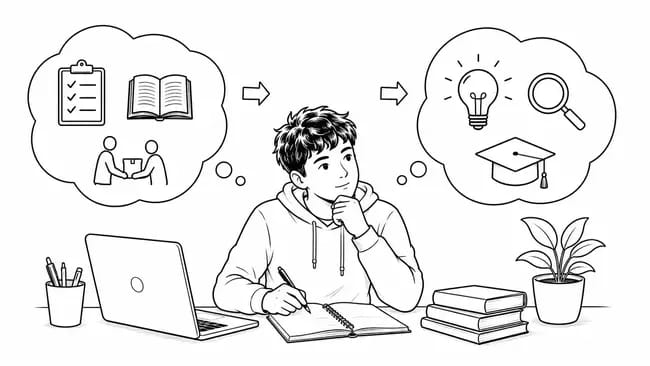
Reflection is what turns an activity into useful evidence. This guide explains how to move beyond describing what you did, show what you learned, and make each example more relevant to your UCAS personal statement.
Reflection is one of the most important, yet least understood, skills in personal statement writing. Many applicants describe their experiences clearly but stop short of showing what those experiences actually mean. Reflection is how you show learning, maturity, and readiness for university study.
What Reflection Means in a Personal Statement
In academic writing, reflection means showing awareness of what an experience taught you, how it changed your understanding, or how it connects to your future study. In a UCAS personal statement, reflection is the stage that turns a list of activities into evidence of development. It shows that you can think about your experiences rather than simply report them.
A clear way to structure reflective sentences is the three-part rhythm used in our step-by-step guide, How to Write a Personal Statement for UCAS 2026: A Step-by-Step Guide:
- Statement – introduce the idea or activity.
- Evidence – give a specific example that demonstrates it.
- Reflection – explain what it taught you and why that matters.
For example:
Description only: “I volunteered at a local school where I helped students with reading.”
With reflection: “Volunteering at a local school helped me see how small changes in explanation can affect confidence, which strengthened my interest in how communication supports learning.”
Both versions describe the same activity, but only the second shows insight. Admissions tutors are interested in how you think about your experiences, not just in what you have done.
The Difference Between Description and Reflection
Description tells the reader what happened. It often focuses on events, tasks, or timelines. Reflection explains what those events meant, what you learned, or how they changed your perspective. Both are useful, but description alone does not demonstrate learning.
The difference can be put simply:
Description states what you did, focuses on actions or events, is often factual or chronological, and may sound detached.
Reflection explains what you learned, focuses on ideas and insights, is analytical and interpretive, and shows growth and curiosity.
A reflective sentence usually answers one or more of these questions:
- What did I learn about the subject or about myself?
- What new skills or approaches did I develop?
- How did this change how I think about studying the subject?
- Why does this experience make me better prepared for university?
Reflection is not self-praise. You are not trying to show that everything went perfectly. Instead, you are showing that you can learn from experience. For examples of how a lack of reflection weakens real applications, see Common Personal Statement Mistakes (and How to Avoid Them).
This helps you check whether each paragraph is genuinely analytical rather than just a well-written summary of events.
Practical Reflection Prompts
Using questions as you draft makes it easier to move beyond description:
For academic study or projects
- Which idea or topic challenged you most, and why?
- How did this change the way you approach learning or problem-solving?
- What did you discover about your subject through this work?
For wider reading or super-curricular activities
- What did this reading or activity add to your understanding?
- Did it confirm or question something you had studied in class?
- What new questions or interests did it spark?
For practical experience or placements
- Which skill or quality did you develop through this experience?
- What aspect of the placement surprised you?
- How did it connect to your academic interests or future plans?
For extracurricular or personal activities
- How did this experience affect the way you think or organise yourself?
- What did you learn about responsibility, collaboration, or resilience?
- In what way does it show readiness for university study?
A reflective sentence often begins with phrases such as “This helped me understand…”, “Through this I realised…”, or “This experience showed me that…”. The language should be formal but personal, avoiding emotional exaggeration.
Mini-Examples of Reflection by Subject
Short examples make the pattern easier to see in practice.
Psychology
“Running a small memory experiment with classmates taught me how easily results can be influenced by factors such as distraction and expectation, deepening my interest in how psychologists control variables in research.”
Engineering
“Building a bridge model for a school competition showed me that small changes in measurements can have a large effect on stability, which strengthened my understanding of why precision is essential in engineering design.”
English Literature
“Comparing a modern novel with a Renaissance play helped me see how writers across periods use narrative voice to question identity, reinforcing my interest in how form shapes meaning.”
Law
“Observing a court hearing made me aware of how tightly legal arguments are tied to evidence rather than opinion, confirming my interest in how law uses structured reasoning to reach decisions.”
Medicine
“Shadowing staff on a hospital ward showed me the balance between analytical decision-making and clear communication with patients, which confirmed that medicine demands both scientific rigour and empathy.”
Education
“Supporting small-group work in a primary classroom helped me realise how consistent encouragement can build confidence, deepening my interest in inclusive teaching approaches.”
Each example starts with an experience and ends with a sentence that interprets it. The reflective element turns a factual summary into evidence of insight and readiness for degree-level study.
These examples show that strong reflection is precise, modest, and closely linked to the subject.
How to Integrate Reflection Naturally
Reflection should be part of each paragraph rather than a separate section at the end.
To integrate reflection smoothly:
- Build paragraphs around ideas, not activities. One paragraph might focus on curiosity about a topic, another on independence or resilience.
- After each example, add a short sentence explaining what you learned or how your thinking changed.
- Vary your phrasing so that reflective sentences do not all begin in the same way.
If you are writing within the three-question UCAS 2026 format, reflection should appear in all your answers, not only in the second question on preparation. This helps your whole statement feel thoughtful and analytical, rather than descriptive in some sections and reflective in others.
For an overview of how the new structure works, see How the UCAS 2026 Personal Statement Questions Work: Official Structure Explained.
Why Reflection Matters in UCAS Applications
Understanding why universities value reflection can increase your motivation to practise it.
Admissions tutors use the personal statement to judge how you think, not just what you have done. A reflective approach shows that you are an active learner who can evaluate experiences and apply learning independently. UCAS guidance for teaching applicants, such as the Teaching 2026 personal statement guide, emphasises reflection on classroom experience rather than listing activities. University study skills resources, such as the University of Bristol’s guidance on writing reflectively, make a similar point: strong reflection combines personal experience with critical thinking.
For UCAS applications, reflective sentences are strong evidence of readiness for independent study. They show that you can connect classroom learning, wider reading, and real-world experience in a thoughtful way.
Conclusion
Reflection turns information into evidence. It shows that your experiences have meaning beyond simply completing activities, and that you can analyse what you have learned. Under the UCAS 2026 question-based format, reflective writing helps you answer all three questions with depth and clarity.
By adding short reflective lines to each key example, you demonstrate that you are aware, curious, and ready to learn independently. Instead of letting paragraphs end with description, use one final sentence to explain why the experience mattered and how it shaped your approach to study.