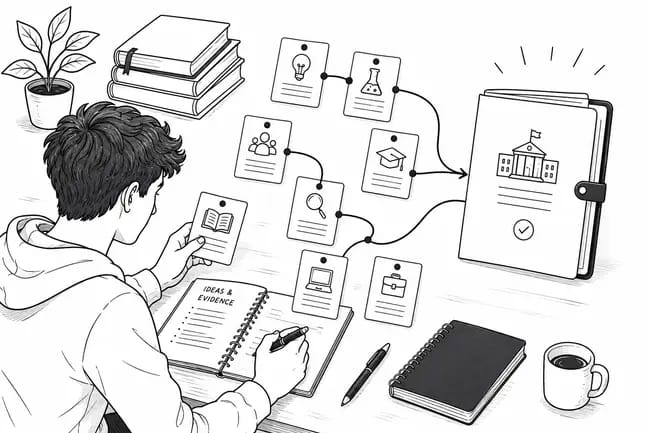
A clear academic thread is good. Repeating the same example, skill or motivation is not. The strongest UCAS statements use each answer for a different purpose.
A clear thread is not repetition
The three UCAS personal statement questions are designed to give your answer structure. They also create a risk: you can end up saying the same thing three times.
For 2026 entry, the personal statement is split into three questions:
- Why do you want to study this course or subject?
- How have your qualifications and studies helped you to prepare for this course or subject?
- What else have you done to prepare outside of education, and why are these experiences useful?
Each question has a different job. Question 1 explains your course motivation. Question 2 shows preparation through study. Question 3 adds wider preparation beyond formal education.
Repetition happens when those answers start doing the same job.
The aim is not to make each answer completely separate. Your statement should still have a clear academic thread. The reader should understand why you want the course, how your studies support that choice, and what else you have done to prepare.
A thread connects the answers.
Repetition duplicates them.
For example, a psychology applicant might have a clear thread around memory and behaviour:
- Question 1 explains interest in how memory affects decision-making.
- Question 2 links that interest to psychology and biology topics studied at school.
- Question 3 uses wider reading or relevant experience to deepen the point.
That works. The answers are connected, but each one adds something different.
A repetitive version would look more like this:
- Question 1: I am interested in memory.
- Question 2: studying psychology made me interested in memory.
- Question 3: I read a book about memory, which increased my interest in memory.
The subject focus is clear, but the evidence is thin. The statement keeps returning to the same idea instead of building a fuller case.
For more on making the answers connect without becoming repetitive, read How to Make Your Three UCAS Personal Statement Answers Work Together.
Give each example one main job
Before drafting, decide what each example is doing.
A book, lecture, work placement, project, competition, job or family responsibility should have one main purpose in the statement.
For example, a book about economics could be used to:
- explain why you became interested in the subject
- show independent reading beyond school
- introduce a specific idea you want to study further
- show how your thinking changed
Choose the strongest role.
If the book is mainly about subject motivation, use it in Question 1. If it is mainly evidence of independent preparation, use it in Question 3. Do not use it in both unless each mention adds something genuinely different.
Most repeated examples are not doing different jobs. They are filling space.
Where repetition appears in UCAS personal statements
Repetition is not always obvious. You do not have to copy the same sentence twice for the statement to feel repetitive.
It usually appears in five ways.
1. Repeating the same motivation
This happens when every answer returns to the same reason for choosing the course.
For example:
I want to study law because I care about justice.
That may belong in Question 1, but it cannot carry the whole statement. Question 2 needs academic preparation. Question 3 needs wider evidence.
A stronger plan would be:
- Question 1: interest in how law balances rights and public order
- Question 2: preparation through politics, history or essay-based study
- Question 3: relevant reading, court observation or legal work experience
The motivation remains visible, but it does not take over every answer.
2. Repeating the same example
This is one of the easiest mistakes to make.
An applicant mentions the same work experience in Question 1, again in Question 2, and again in Question 3. Each version uses slightly different wording, but the evidence is the same.
That makes the application look narrow.
If a hospital placement is the strongest experience in a medicine application, it probably belongs in Question 3. Question 1 can explain academic interest in medicine or healthcare. Question 2 can focus on preparation through science subjects. The placement does not need to do every job.
3. Repeating the same skill
Students often repeat broad skills such as communication, teamwork, leadership, resilience, organisation or problem-solving.
These skills become weak when they appear as repeated claims.
For example:
- My studies improved my communication skills.
- My volunteering improved my communication skills.
- My job improved my communication skills.
This tells the reader little.
A stronger sentence is more precise:
Volunteering in a care home taught me that communication is not only about speaking clearly. It also means noticing when someone is confused, anxious or reluctant to ask for help.
That earns its space. It does not need to be repeated elsewhere.
4. Repeating the same sentence pattern
A statement can sound repetitive even when the examples are different.
Watch for repeated openings such as:
- This taught me...
- This helped me...
- This developed my...
- This made me realise...
- This experience showed me...
These phrases are not banned. The problem is overuse.
Instead of writing every reflection in the same shape, vary the sentence structure:
Reading about behavioural economics introduced me to the idea that people do not always make rational financial choices. I became particularly interested in how small changes in framing can influence decision-making.
This sounds more natural than forcing the paragraph into a repeated “this taught me” pattern.
5. Repeating information already in UCAS
Your UCAS application already includes your qualifications, school or college details and predicted grades. The personal statement should not repeat them as a list.
Weak:
I study Biology, Chemistry and Psychology.
Stronger:
Studying genetics in Biology helped me understand how molecular processes connect to inherited conditions, while Chemistry strengthened my confidence with quantitative problem-solving.
The stronger version uses the same academic background, but it adds meaning.
For more on keeping a consistent subject focus without repeating yourself, read How to Keep a Clear Academic Thread Through Your Personal Statement.
Map your evidence before drafting
The best way to avoid repetition is to map your evidence before you write.
Use a simple table:
| Evidence |
Best question |
Main purpose |
Used already? |
| Topic, debate or idea that interests you |
Question 1 |
Explain subject motivation |
Yes / No |
| School topic, essay, project or practical work |
Question 2 |
Show academic preparation |
Yes / No |
| Reading, work experience, volunteering or independent project |
Question 3 |
Show wider preparation |
Yes / No |
This forces you to choose the best place for each example.
If one example appears in more than one row, ask why. If you cannot explain the different purpose clearly, move it to the strongest section and cut the repeat.
Can you use the same example twice?
Sometimes, but be careful.
You can repeat an example only if each use does a genuinely different job.
For example, an extended project on renewable energy might support:
- Question 1, if it sparked your interest in engineering or environmental science
- Question 2, if it involved technical research, data analysis or scientific knowledge
- Question 3, if it was completed independently outside the main curriculum
Even then, using it three times may be too much. It is often better to use the example once, explain it well, and use other evidence elsewhere.
If your statement depends heavily on one example, you may need more material before drafting.
How to edit repetition out of your draft
Read the three answers together. Do not edit each answer in isolation.
Use this checklist.
1. Highlight repeated examples
Look for the same book, placement, project, job, hobby, topic or experience appearing more than once.
Keep the strongest use. Cut or replace the weaker one.
2. Highlight repeated claims
Watch for claims such as:
- I am interested in the subject.
- I developed communication skills.
- I enjoy solving problems.
- I want to help people.
- I want to make a difference.
If a claim appears more than once, replace it with evidence or remove it.
3. Check each answer has its own role
Question 1 should explain motivation. Question 2 should show academic preparation. Question 3 should add wider preparation.
If two answers are doing the same job, revise the weaker one.
4. Cut repeated closing sentences
Many applicants end every answer by saying the experience has prepared them for university.
You do not need to keep saying this. The evidence should make the point.
For careful final editing, read Editing and Proofreading Your Personal Statement (Without Losing Your Voice).
Final advice
Repetition makes a personal statement weaker because it wastes space and reduces the range of evidence.
A clear academic thread is different. That thread should run through the statement, but each answer should add something new.
Before drafting, decide what each example proves. During editing, check whether the same motivation, example, skill or sentence pattern appears more than once.
Keep the thread. Cut the duplicate content.
FAQs
Can I repeat an example in more than one UCAS personal statement answer?
Only if each use does a different job. In most cases, use the example once and make the explanation stronger.
How do I stop my three UCAS answers sounding the same?
Give each answer a different role: motivation, academic preparation and wider preparation. Then check that each example appears in the best place only once.
What is the difference between a clear academic thread and repetition?
A clear academic thread means all three answers support the same course choice. Repetition means using the same content, claim or example again without adding anything new.
Is it bad to repeat the course name?
Repeating the course name too often wastes space and can sound mechanical. Use the space to explain your interest, preparation and evidence instead.