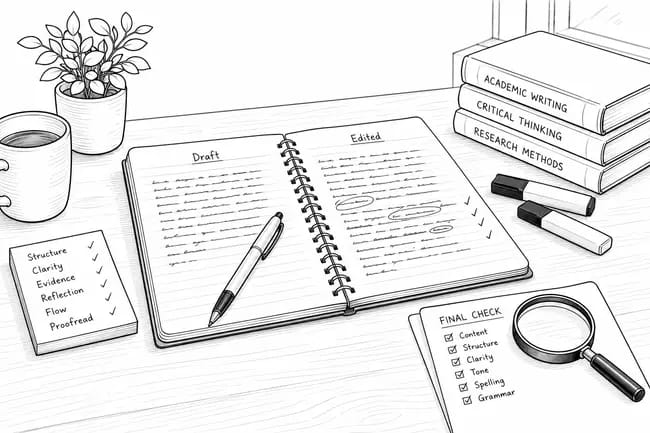
Editing should make your personal statement clearer, not less personal. The aim is to sharpen your structure, evidence and wording while keeping the statement recognisably yours.
Why editing matters
Once you have completed a first draft of your personal statement, the most important work begins.
Editing is not just checking commas or cutting words to fit the character limit. It is the process of turning a rough set of ideas into a clear, focused and convincing application. Proofreading then catches the errors that can distract from your meaning.
The challenge is doing both without making the statement sound as if it has been written by someone else. A good edit should make your personal statement clearer, sharper and more purposeful, not replace your wording with over-formal phrases or turn your writing into a template.
A first draft is rarely the best version of a personal statement. Most early drafts have repeated examples, vague claims, long sentences, misplaced content, or too much description and not enough reflection.
Editing helps you decide what belongs, what should move, and what should be cut.
For 2026 entry, the UCAS personal statement is structured around three questions:
- Why do you want to study this course or subject?
- How have your qualifications and studies helped you to prepare for this course or subject?
- What else have you done to prepare outside of education, and why are these experiences useful?
Admissions staff will still read the statement as a whole, so your answers need to work together. Each answer should do its own job, but the overall statement should feel consistent.
For a clear explanation of the new format, read How the UCAS 2026 Personal Statement Questions Work (Official Structure Explained).
Edit in the right order
Do not start by correcting individual words. If the structure is weak, polishing sentences will not fix the statement.
Work from the biggest issues to the smallest ones:
- structure
- focus
- evidence
- reflection
- sentence clarity
- proofreading
This stops you wasting time perfecting a paragraph that later needs to be cut.
1. Check the structure
Start by asking whether each UCAS answer does the right job.
Question 1 should explain your course motivation. It should show why the subject interests you and what kind of academic interest you have.
Question 2 should show how your studies have prepared you. It should not simply list your subjects or grades.
Question 3 should add relevant preparation beyond formal education. This might include reading, work experience, volunteering, employment, online courses, independent projects, competitions, caring responsibilities or other useful experience.
A common editing problem is misplaced content. For example, a book that sparked your interest in the subject may belong in Question 1. A school project that developed your research skills may belong in Question 2. A work placement or independent online course may belong in Question 3.
Do not obsess over perfect boundaries, but do make sure each answer has a clear purpose.
2. Remove repetition
Repetition is one of the easiest ways to weaken a personal statement.
Look for repeated examples, claims, skills, sentence openings, explanations of motivation, and broad statements about passion or interest.
A repeated academic thread is fine. Repeated content is not.
For example, if you are applying for psychology, it is fine for the whole statement to show interest in behaviour, memory or development. That gives the statement focus. But if you mention the same book, same topic or same work experience in all three answers, the statement starts to feel thin.
Keep the strongest use of an example and cut the weaker repeats.
Weak repetition:
My volunteering developed my communication skills. My part-time job also improved my communication skills. My studies have also helped me communicate more clearly.
Stronger:
Volunteering in a care home taught me that communication is not only about speaking clearly. It also means noticing when someone is confused, anxious or reluctant to ask for help.
The stronger version uses one example properly instead of repeating a generic skill.
3. Strengthen the evidence
A personal statement is stronger when it uses evidence instead of claims.
Claims are easy to write:
- I am passionate about law.
- I am hardworking.
- I have strong communication skills.
- I am ready for university study.
These statements do little on their own. They need proof.
Better editing turns claims into evidence:
Studying protest and public order made me interested in how the law balances individual rights with state authority.
Completing my history coursework helped me manage a longer research process, compare sources and build a more careful argument.
Working with younger students taught me to explain tasks clearly and adjust when someone had misunderstood.
You do not need to make every sentence dramatic. You need to make the evidence specific.
4. Improve reflection
Many drafts describe experiences without explaining what the applicant learnt from them.
Description says what happened. Reflection explains why it matters.
Weak:
I completed work experience at a solicitor’s office and observed different tasks during the week.
Stronger:
Work experience at a solicitor’s office showed me how much legal work depends on careful written communication. I was struck by how advice had to be accurate, concise and understandable to clients without legal training.
The second version is better because it shows thought. It does not just report the activity.
Use reflection carefully. Do not end every paragraph with “this taught me the importance of...” or “this developed my skills in...”. Those phrases become repetitive quickly.
A useful test is:
Have I explained what this example shows about my preparation for the course?
If not, the paragraph needs editing.
5. Cut filler and vague language
Filler makes a statement longer without making it stronger.
Common filler includes phrases such as “from a young age”, “I have always been passionate about”, “in today’s society”, “I want to make a difference”, “this opportunity allowed me to”, and “I gained many valuable skills”.
Some of these phrases can be true, but they are rarely the sharpest way to make a point.
Weak:
I have always been fascinated by biology because it helps us understand the world around us.
Stronger:
Studying genetics helped me understand how molecular changes can affect health, inheritance and treatment decisions.
The edited version is more precise. It gives the reader an academic reason for the interest.
6. Keep your own voice
Editing should not make your statement sound artificial.
Your voice is not slang, jokes or overly casual writing. It is the natural way you explain your thinking. A personal statement should sound polished, but still recognisably yours.
To keep your voice, use words you understand and would use confidently. Avoid replacing simple words with awkward formal alternatives. Keep the sentence meaning close to your original idea. Read the statement aloud, and question edits that make you sound unlike yourself.
Over-edited writing often sounds like this:
My multifaceted academic engagement has cultivated a profound appreciation of the interdisciplinary nature of biomedical inquiry.
That sentence is trying too hard.
A clearer version would be:
Studying biology and chemistry together helped me see how biomedical science connects molecular processes with practical questions about diagnosis and treatment.
The second sentence is still academic. It is also readable.
7. Get feedback without losing control
Feedback is useful, but too many editors can damage a personal statement.
One person tells you to sound more confident. Another tells you to be more reflective. A third rewrites your opening sentence. By the end, the statement can lose direction.
Ask one or two trusted readers for specific feedback:
- Does each answer address the UCAS question?
- Is any section repetitive?
- Are any examples unclear?
- Does anything sound exaggerated or forced?
- Does it still sound like me?
Do not ask people simply whether they “like it”. That leads to vague opinions. Ask them to help you find problems.
You are still responsible for the final version. If a suggested edit changes your meaning or makes the statement sound false, do not use it.
8. Proofread after editing
Proofreading comes last. There is no point fixing punctuation in a sentence you later cut.
Once the structure, evidence and wording are settled, check spelling, missing words, repeated words, punctuation, capitalisation, sentence length, formatting, copied text and character count.
Read slowly. Then read the statement again in a different format if possible. Errors are easier to spot when the text looks different.
Also check how the statement appears when pasted into UCAS. Formatting can change, and the character count matters.
Final proofreading checklist
Before submitting, check:
- Have I answered all three UCAS questions clearly?
- Does each answer have a different purpose?
- Have I removed repeated examples and claims?
- Is every example linked to the course or to my readiness for study?
- Have I explained what I learnt, not just what I did?
- Is the language clear and natural?
- Does the statement still sound like me?
- Have I checked spelling, grammar and punctuation?
- Have I checked the character count in the UCAS system?
If the answer to each question is yes, the statement is ready for a final read.
Final advice
Editing should make your personal statement more precise, not less personal.
Cut repetition. Strengthen evidence. Make your reflections clearer. Remove phrases that sound impressive but say little. Then proofread carefully.
The final statement should sound like you on a good day: focused, thoughtful and clear.