Can You Use AI or ChatGPT to Help Write a Personal Statement?
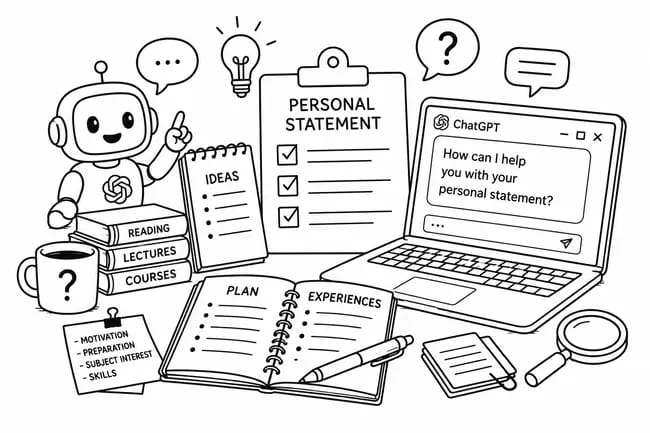
AI can help with a personal statement, but only if it supports your own thinking rather than replacing it. This guide explains where tools like ChatGPT can be useful, where they become risky, and how to keep your statement accurate, personal and genuinely your own.
Students use ChatGPT, Gemini, Claude or similar tools for schoolwork, planning, note-making, or editing, so it is natural to wonder whether the same tools can be used for a UCAS personal statement. The question is no longer hypothetical. For many applicants, it is already part of the writing process.
AI can be used as a support tool, but it should not replace your own thinking, experiences, or writing.
The personal statement is meant to be personal: universities want to understand why you want to study the course, what has prepared you for it, and how your experiences and interests make you a suitable applicant. If AI takes over that job, the result often becomes generic, inaccurate, and much less convincing.
UCAS makes this point clearly in its guidance on AI tools. It says that generating and submitting all or a large part of a personal statement from an AI tool such as ChatGPT, and presenting it as
your own words, could be considered cheating by universities and colleges and could affect your chances of an offer. Applicants must declare that their personal statement has not been copied or provided from another source, including artificial intelligence software. You can read the official guidance here: UCAS: A guide to using AI and ChatGPT with your personal statement.
The key distinction: support versus replacement
Using AI as a support tool means using it to help you think, plan, organise, or refine your ideas. Using AI as a replacement means asking it to generate the statement for you, invent examples, or produce polished paragraphs that you then submit as if they were entirely your own.
Those are not the same thing.
A support use might involve asking for help structuring your ideas, generating planning questions, simplifying a confusing sentence, or spotting repetition in a draft you wrote yourself. A replacement use might involve asking ChatGPT to write your first answer to the UCAS questions, create examples of work experience you did not have, or turn a few vague prompts into a full statement that sounds more like the tool than like you.
UCAS’s own guidance recognises this difference. It says AI tools can be useful for brainstorming, structure, and readability checks, but it also warns that using AI to write the statement for you may harm your chances of an offer.
Need the full personal statement process?
This page focuses on one part of your application. For the full route through planning, structuring, drafting and editing your answers, use the main UCAS personal statements guide.
Go to the main guide →What AI can help with usefully
Used carefully, AI can help at several stages of the process.
Brainstorming ideas
If you are unsure where to start, AI can help you think of possible angles, topics, or questions. For example, it might help you identify subject-related themes worth reflecting on, prompt you to think about relevant experiences, or suggest broad areas of reading, work experience, or super-curricular activity to consider.
This can be especially useful if you feel stuck or feel you have too little material. The tool may help you notice that your schoolwork, responsibilities, reading, or part-time work are more relevant than you first thought.
Planning and structure
AI can also help you organise material you already have. For example, you might ask it to help group your ideas under motivation, academic preparation, and useful experience outside education. Under the UCAS 2026 format, that kind of structural support can be useful if you are unsure where different examples fit.
That said, planning is only helpful if the substance still comes from you.
Editing for clarity
Once you have a draft, AI can sometimes help you identify repetition, simplify awkward sentences, or spot places where your meaning is unclear. This is closest to using a digital editor. If the original ideas and examples are yours, using a tool to improve readability can be reasonable.
Asking better reflective questions
One of the most useful ways to use AI is not to ask it for answers, but to ask it for questions. For example, you might ask what kinds of follow-up questions could help you reflect more deeply on a book you read, a work experience placement, or a school project. That can help you think more analytically about your own material.
What AI should not do
The simplest rule is that AI should not replace your authorship.
That means it should not:
- write the whole statement for you
- write large chunks that you paste in unchanged
- invent experiences, reading, achievements, or skills
- exaggerate your involvement in activities
- produce a polished voice that is not recognisably yours
- make your statement sound more impressive by making it less truthful
This matters for both ethical and practical reasons. The ethical reason is straightforward: submitting AI-written content as your own misrepresents authorship. The practical reason is just as important: false or generic writing often creates problems later.
UCAS states that its Verification Team runs checks for fraud and patterns of similarity in personal statements, and that if its software detects elements of a statement that are similar to others, universities or colleges may be notified. UCAS also checks for false, missing, or misleading information in applications more broadly. That does not mean there is a magic AI detector that can perfectly identify every sentence. It does mean there are real risks in submitting work that is not genuinely your own.
The main risks of using AI badly
Students are often warned not to rely too heavily on AI, but it helps to be clear about why.
Generic language
AI-generated writing sounds polished at first glance, but many personal statements produced this way end up sounding interchangeable. They use broad claims about passion, ambition, justice, innovation, or wanting to make a difference without giving specific personal detail. Bland AI-generated statements are not what universities and colleges are looking for.
False or distorted experiences
AI may invent details, overstate what an activity involved, or fill gaps with things you never did. Even small distortions can become a problem if you are later asked about them at interview or in a follow-up process.
Loss of voice
A statement written too heavily with AI often stops sounding like a real applicant. The tone may become too formal, too smooth, or strangely detached from the kinds of examples it includes. That can weaken the application even if every sentence sounds grammatically correct.
Overdependence
Students who rely too much on AI sometimes stop doing the harder but more important thinking themselves. They end up with a statement that looks finished but is intellectually thin. The process of planning and writing often helps students clarify why they are applying, what evidence they actually have, and which examples are strongest. If AI skips that thinking, the statement often suffers.
Repetition and mismatch
Under the UCAS 2026 format, one common risk is that AI produces answers that repeat the same ideas across all three questions or place examples in weak, formulaic ways. UCAS reviews the statement as a whole, so repeated material and generic overlap can quickly reduce its impact.
For related drafting problems, see Common Personal Statement Mistakes (and How to Avoid Them).
Why authenticity matters
Authenticity is not just a moral slogan. It is part of what makes a statement convincing.
Admissions tutors are not reading to see whether your writing is tidy. They are reading to understand how you think about the subject, what has shaped your interest, and how you reflect on your own experiences. That is difficult for AI to replicate well because it depends on real specificity.
A sentence about reading a book is not useful unless it shows what that reading made you notice. A sentence about work experience is not persuasive unless it reflects what you genuinely observed and learned. A sentence about motivation needs to sound rooted in your own reasons for applying, not in a generic model of what a good applicant ought to say.
This is why authenticity and quality are closely linked. A statement that sounds genuinely yours is stronger because it contains details, judgements, and reflections that a generic tool cannot easily invent convincingly.
That is also why the editing stage matters so much. If you use any digital support at all, the final version still needs to sound like you. Editing and Proofreading Your Personal Statement (Without Losing Your Voice) is especially relevant here.
How to use AI ethically for brainstorming, planning, and editing
A sensible ethical approach is to treat AI as a limited assistant rather than as a ghostwriter.
You might use it to:
- generate planning questions about your course choice
- help you sort examples into useful categories
- suggest clearer paragraph order
- identify vague phrases in your draft
- point out repeated words or repeated ideas
- suggest where a sentence is unclear or too long
You should not use it to decide what your experiences meant for you. That reflective work needs to come from your own thinking.
A good test is this: if you removed the tool, would the core ideas, examples, and wording still clearly belong to you? If the answer is no, the tool is probably doing too much.
This can be especially helpful for students who are stuck at the start. If that is your position, How to Start Your Personal Statement (With Examples) and How to Write a Personal Statement With Little or No Experience are both better foundations than asking AI to generate a finished answer.
Signs AI has made the statement worse
Sometimes students use AI with good intentions but the end result is still weaker. There are several warning signs to look for.
- The statement sounds polished but vague.
- It includes phrases you would never naturally use.
- It makes you sound more certain or experienced than you really are.
- The examples feel flattened rather than specific.
- Multiple paragraphs say roughly the same thing in different words.
- The tone is formal but impersonal.
- You would struggle to explain or defend parts of it in conversation.
- It sounds like a model answer rather than your own application.
If you notice those signs, the solution is usually not small edits. It is to go back to your own notes and rebuild the material from your real examples and reflections.
A practical responsible-use workflow
If you want to use AI without letting it take over, a simple workflow can help.
Step 1: Start offline or in your own notes
Write down your actual reasons for applying, your strongest examples, the reading or experiences that mattered, and what each one showed. Do this before asking AI anything substantial.
Step 2: Build a rough plan yourself
Group your material into motivation, academic preparation, and useful experiences outside education. Identify the best examples first.
Step 3: Draft in your own words
Write a rough first version yourself, even if it is messy. This is the most important stage because it preserves authorship and voice.
Step 4: Use AI only for limited support
At this point, you might ask for help spotting repetition, improving clarity, or generating reflective questions about places where your analysis is thin.
Step 5: Check every sentence for truth and voice
Ask yourself whether each point is accurate, whether it sounds like you, and whether you could explain it naturally if asked.
Step 6: Get human feedback as well
Teachers, advisers, and trusted readers are often better than AI at noticing whether the statement sounds genuine, relevant, and balanced.
Step 7: Do a final authenticity check
Before submitting, reread the whole statement and remove anything that sounds imported, over-polished, or too generic to be truly yours.
This kind of process keeps AI in a secondary role, which is where it belongs.
Final thoughts
So, can you use AI or ChatGPT to help write a personal statement?
Yes, but only if help really means support. AI can be useful for brainstorming, planning, and light editing. It becomes a problem when it starts replacing your own thinking, writing, or experiences.
The safest and strongest approach is to keep authorship with you. Use AI, if at all, as a tool to clarify what you already know, not as a machine to generate a convincing version of you. Universities want your motivations, your reflections, and your evidence. That is what makes a statement persuasive.
If a tool helps you get there more clearly, that can be useful. If it starts speaking for you, it has gone too far.
Continue reading
Common Personal Statement Mistakes (and How to Avoid Them)Most weak personal statements are not ruined by one major mistake. They lose impact through poor choices: vague claims, repeated examples, misplaced evidence, and too little reflection. This guide shows the most common problems and how to make each answer more focused, specific and useful.
Choosing the right course →
Use the course choice guide to compare subjects, course structures, modules, entry requirements and future options before narrowing your university decisions.