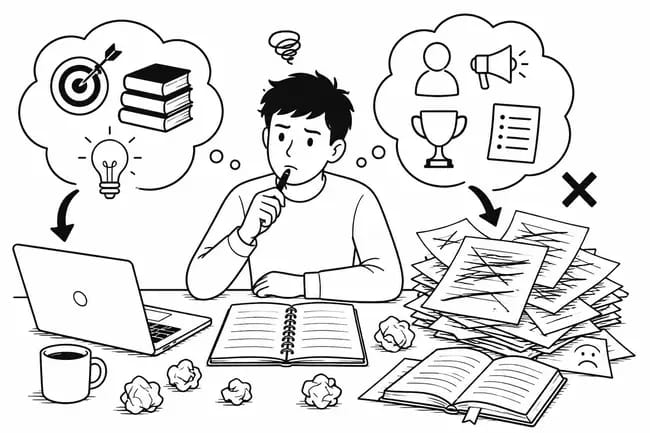
Most weak personal statements are not ruined by one major mistake. They lose impact through poor choices: vague claims, repeated examples, misplaced evidence, and too little reflection. This guide shows the most common problems and how to make each answer more focused, specific and useful.
Most personal statements are not undermined by a total lack of material. The damage is usually smaller and more frustrating than that. Good ideas are buried under weak examples. Strong evidence is repeated too often. Space is handed to points that do not help the application very much. The result is a statement that may sound competent on the surface, but does not make the strongest possible academic case.
The 2026 UCAS format makes those weaknesses easier to see. Each answer has a clearer job, so poor sorting stands out more sharply. Repetition becomes more obvious. Misplaced material is harder to hide. Thin content looks thinner. If you want the full explanation of how the structure works, start with How the UCAS 2026 Personal Statement Questions Work: Official Structure Explained. This guide is about what goes wrong once students begin drafting, and how to avoid it.
What changes in the 2026 format
The basic purpose of the personal statement has not changed. Universities still want to understand your course motivation, your academic preparation, and the useful preparation you can show from outside formal study. What has changed is the visibility of mistakes.
A weak draft now shows its problems more quickly:
- the same example appears in more than one answer
- formal study drifts into the wrong section
- extracurricular material takes up too much space
- broad claims are left unsupported
The three answers should do different jobs, but they still need to feel like one application. That balance is where many weaker drafts start to slip.
Mistake 1: Focusing on yourself more than the subject
A personal statement is not the place for a long self-portrait. General claims about being hardworking, curious, determined, or ambitious do very little on their own. Admissions tutors are not trying to build a personality profile. They are looking for evidence that you are ready to study a particular subject.
Less effective
“I am a determined, curious, and hardworking person who always gives my best in everything I do.”
Stronger
“Studying coastal change in geography made me more interested in how physical processes shape human decisions.”
The second version gives the subject priority. Personal qualities may still come through, but they do not need to be announced in advance. The statement becomes stronger as soon as it starts doing academic work.
Mistake 2: Relying on examples that are too old or too distant
Early childhood anecdotes are one of the weakest habits in personal statement writing. They may feel personal and memorable, but they rarely add much. Universities are not selecting the child you were. They are selecting the applicant you are now.
Less effective
“When I was seven, I loved helping my grandparents in the garden, which first inspired my interest in Biology.”
Stronger
“Studying plant responses in biology and reading more about ecosystems made me more interested in how environmental systems adapt to change.”
A brief origin point can survive if it is handled very carefully, but it should never take up valuable space that could be used for recent, academic evidence. Current subject engagement is far more persuasive.
Mistake 3: Claiming enthusiasm without showing it
Many drafts lean too heavily on phrases such as “I have always been passionate about” or “I am fascinated by”. Those expressions are easy to write and easy to overuse. They also prove very little. Enthusiasm is more convincing when it is shown through what you have read, explored, questioned, or learned.
Less effective
“I have always been passionate about psychology.”
Stronger
“Reading about memory biases made me more interested in how psychology challenges everyday assumptions.”
The second version gives the reader something concrete. A subject interest becomes believable when it has shape and content behind it. How to Show Enthusiasm Without Saying ‘I Am Passionate’ covers this problem in more detail.
Mistake 4: Listing experiences without reflection
A statement can contain plenty of activity and still say very little. Books, lectures, placements, volunteering, competitions, and projects do not automatically strengthen an application. Naming them is only the starting point. The real value lies in what they changed in your understanding.
Less effective
“I completed a placement in a primary school and attended a lecture on child development.”
Stronger
“Observing how differently pupils responded to the same task made me think more carefully about how attention and confidence affect learning.”
The experience matters less than the thought it produced. Reflection is what turns a list into an argument. Without it, the reader learns what you did, but not why it belongs in the statement. For help with that shift, read How to Reflect on Experience in Your Personal Statement.
Mistake 5: Repeating the same example across multiple questions
One strong example can end up carrying too much of the statement. A student with a good piece of work experience or one substantial project may try to use it everywhere. Used once, the example may be effective. Used three times, it starts to look thin.
A hospital placement, for example, can easily end up appearing in all three answers:
- in one answer as proof of motivation
- in another as evidence of preparation
- in a third as useful experience outside education
That approach feels repetitive very quickly.
Less effective
Building all three answers around the same placement or project.
Stronger
Giving the placement one clear home, then using different material elsewhere to develop the rest of the case.
The three answers should connect, but they should not recycle the same centrepiece repeatedly. Strong planning solves this before drafting even begins.
Mistake 6: Misplacing material between Questions 2 and 3
The line between Questions 2 and 3 is easy to blur, and weak drafts do exactly that. Formal study belongs in one place. Preparation outside formal education belongs in another. Once those categories start drifting into each other, the statement loses structure.
Less effective
Using coursework, classroom essays, and subject lessons as the main evidence in Question 3.
Stronger
Keeping coursework and structured study in Question 2, then using wider reading, lectures, work experience, or volunteering in Question 3.
This is not a small technicality. It affects the logic of the whole application. Each example should feel as though it has been placed deliberately, not dropped into whichever answer had space left.
Mistake 7: Giving too much space to extracurriculars
Extracurricular activities are easy to write about because they are concrete. Sport, music, leadership, volunteering, part-time work, and caring responsibilities can all sound substantial. The danger is not mentioning them at all. The danger is letting them dominate a statement that should still be centred on academic readiness.
Less effective
A full paragraph on captaining a football team, with only a brief mention of the course itself.
Stronger
A short reference to captaining the team to show discipline and communication, while keeping the main emphasis on subject engagement and academic preparation.
General extracurriculars still have a place, but not at the centre. Their role is supportive. If the statement sounds more like a character profile than a case for study, the balance has gone wrong. Balancing Academic and Extracurricular Content explores this in more detail.
Mistake 8: Using generic skills language
Words such as communication, teamwork, leadership, resilience, and problem-solving appear constantly in personal statements. They are not useless words, but they are weak when left vague. A skill means very little until the reader can see where it came from and why it matters here.
Less effective
“This improved my communication and teamwork skills.”
Stronger
“Balancing shifts with coursework taught me to prioritise tasks and communicate clearly under pressure.”
The second version works because it gives the skill a setting. It also links that skill to demands that make sense in university study. Broad labels on their own do not achieve much.
Mistake 9: Sounding artificial, inflated, or over-written
Some drafts try so hard to sound impressive that they stop sounding real. The language becomes grand, abstract, or strangely impersonal. This can happen when students imitate formal writing too closely, rely on templates, or accept polished-looking phrasing that carries very little meaning.
Less effective
“I have long harboured an unwavering fascination with the intricate mechanisms that underpin society.”
Stronger
“Studying inequality in sociology made me more interested in how policy shapes everyday life.”
Clear writing nearly always beats inflated writing. The aim is not to sound grand. The aim is to sound precise, thoughtful, and believable. How Admissions Tutors Read Your Statement is useful here, because it helps clarify what readers actually respond to.
Mistake 10: Failing to edit for space, precision, and overall coherence
Editing is not just a final tidy-up. It is part of the thinking. Weak drafts often contain padding, repeated claims, loose phrasing, and sentences that do not earn their place. In a character-limited application, that costs you twice: once in wasted space, and once in lost sharpness.
Less effective
“I believe that this experience helped me to develop skills that will be useful at university.”
Stronger
“This experience strengthened my ability to manage deadlines independently.”
The second sentence is shorter, cleaner, and more definite. That kind of edit matters. Across a whole statement, it can create room for stronger evidence and clearer reflection. Editing and Proofreading Your Personal Statement (Without Losing Your Voice) takes this further.
A quick self-check before you submit
Before you submit, it is worth asking a few direct questions:
- Is the subject still at the centre of the application?
- Does each answer do a different job?
- Have I explained what my examples show?
- Have I relied on material that is too old, too vague, or too weak?
- Have I repeated the same point in more than one section?
- Does every sentence earn its space?
A draft does not need to be perfect. It does need to be controlled.
Conclusion
Most personal statement mistakes are not dramatic. They are mistakes of judgement. A weak example is chosen over a stronger one. A good example is stretched too far. Description replaces reflection. Personal detail crowds out academic content. Editing comes too late, or not at all.
The fix is rarely to invent better material. More often, it is to choose more carefully, place examples more intelligently, and say more with less. Keep the subject central, use current and relevant evidence, and make sure each answer contributes something distinct to one coherent academic case. That is what makes a statement sound focused, credible, and worth serious attention.