How to Structure a Personal Statement Paragraph
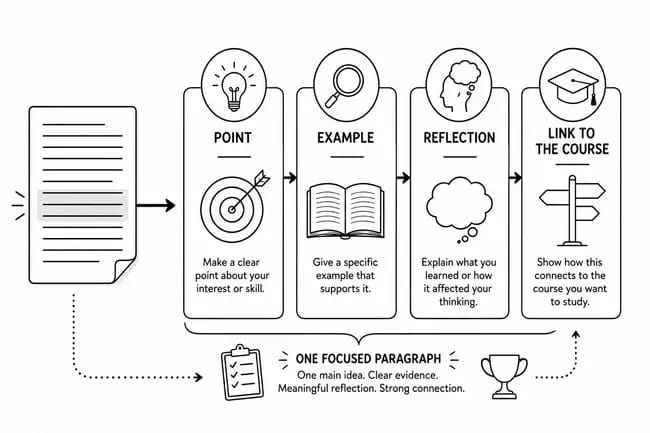
Strong paragraphs do more than sound polished. They make one clear point, support it with evidence, reflect on what the example shows, and link it back to the course. This guide explains how to structure each paragraph so your personal statement feels focused and convincing.
A strong personal statement is built paragraph by paragraph, not sentence by sentence. If a paragraph has no clear point, no real evidence, or no explanation of why the example matters, the whole statement starts to feel loose and repetitive.
The strongest paragraphs do four things: they make a point, support it with a specific example, reflect on what that example shows, and connect it back to the course. Get that structure right, and your statement becomes easier to plan, easier to read, and far more convincing.
Why paragraph structure matters
A personal statement is easier to read, understand and trust when each paragraph has a clear job. Admissions tutors are not only looking for interesting experiences. They are also looking for evidence that you can select relevant material, explain its value, and connect it to the course you want to study.
Personal statement paragraph structure matters here. A strong paragraph introduces one main idea, supports it with a specific example, reflects on what you learned, and shows why that learning matters for the course. If your paragraphs do not do this, the statement can quickly become descriptive, repetitive or difficult to follow.
Good structure also helps you make decisions while drafting. Instead of asking whether a paragraph sounds impressive, ask whether it proves a useful point. That shift leads to clearer writing and stronger evidence.
The basic structure of a strong paragraph
A strong paragraph has four parts:
- point
- example
- explanation (but we're going to call it reflection)
- link to the course
You may recognise this as a version of PEEL. In school writing, PEEL often stands for point, evidence, explanation and link. In a personal statement, the same principle works well, but reflection matters especially because admissions staff want to see how you think about your experiences, not just what you did.
A PEEL personal statement paragraph does not need to sound mechanical. You do not need to force every paragraph into an identical shape. You do need to move from claim to evidence to meaning.
Point
Your opening sentence should establish the main idea of the paragraph. It gives the reader a clear focus from the start. It might identify an academic interest, a skill you developed, or a quality that is relevant to the course.
For example, instead of beginning with a broad scene-setting sentence, you might open with a point such as: you became interested in ethical decision-making through reading and debate, or you developed your analytical skills through a research-based project. The reader then knows what the paragraph is going to show.
Example
After the point, give a specific example. This part of the paragraph shows your claim is grounded in something real. The example might come from academic study, wider reading, work experience, volunteering, competitions, projects or another relevant activity.
Specificity matters here. A paragraph becomes weak when it relies on general statements such as “I have always enjoyed helping people” or “I learned many valuable skills”. Those claims do not tell the reader enough. A stronger example identifies what you did, the context, and what it revealed.
For instance, if you are writing about problem-solving, it is stronger to refer to a particular experiment, extended project, coding task or placement experience than to say you are a good problem-solver in general.
Reflection
Reflection is often the part applicants underuse. They describe the experience, then move on. That creates a list of activities rather than an argument for your suitability.
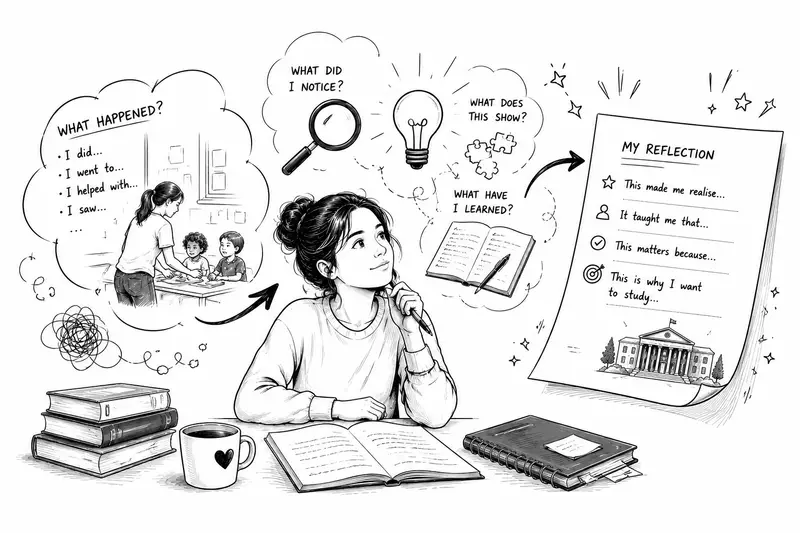
Reflection means explaining what the experience taught you, how it changed your understanding, or what skill it helped you develop. Here, you interpret the example. You are showing that you can learn from experience, not merely collect it.
A reflective sentence often answers one of these questions:
- What did this show you?
- What did you understand more clearly afterwards?
- How did it deepen your interest in the subject?
- What skill did you strengthen, and why does that matter?
If your draft describes events without analysing them, read examples of stronger reflective writing. Our article on Writing Reflective Personal Statement Examples breaks down what reflection looks like in practice.
Link to the course
The final part of the paragraph connects the experience back to the course. This keeps the statement focused on admissions rather than autobiography.
The link does not need to be long. One sentence is often enough. What matters is that the reader can see why the paragraph belongs in this statement. If you describe an activity but never show its relevance to the subject, the paragraph may feel detached from your application.
For example, after discussing a placement or reading experience, you might show that it confirmed your interest in a particular area of the subject, strengthened a skill used in degree-level study, or helped you understand the demands of the course more realistically.
Need the full personal statement process?
This page focuses on one part of your application. For the full route through planning, structuring, drafting and editing your answers, use the main UCAS personal statements guide.
Go to the main guide →One main idea per paragraph
Keep one main idea in each paragraph. This gives the writing shape and makes it easier for the reader to follow.
When a paragraph tries to cover too much, it often becomes unfocused. You may begin with a point about reading, move into volunteering, then mention a school project, and finish with a broad statement about motivation. Even if each part is relevant, the paragraph no longer has a clear centre.
Decide what the paragraph is proving before you write it. One paragraph might show academic curiosity through reading and super-curricular exploration. Another might show communication and responsibility through a relevant role. A third might show problem-solving through a project or practical experience.
This does not mean every paragraph must discuss only one activity. You can combine material if the examples support the same idea. The key is that the paragraph should feel unified. The reader should be able to summarise its purpose in a sentence.
How to avoid description-heavy paragraphs
Many weak paragraphs are not weak because the experience is poor. They are weak because too much of the paragraph is spent narrating what happened.
Description tells the reader what you did. Reflection explains why it matters. In a personal statement, reflection carries more weight. If this is an area you are still trying to sharpen, How to Reflect on Experience in Your Personal Statement is a useful companion guide.
Compare the difference:
A descriptive version might say that you volunteered in a care setting, observed staff, spoke to service users and completed a number of tasks. That gives a basic account of events.
A more effective version would select one or two details from that experience and explain what they taught you about communication, judgement, professional responsibility or the realities of the subject area. The second version is more useful because it interprets the experience rather than simply reporting it.
Check the balance inside each paragraph. If most of the sentences are about what happened, the paragraph needs more analysis. If the example is vague and the reflection is unsupported, the paragraph may need more detail. Strong paragraphs balance both.
A simple paragraph model you can adapt
If you are unsure how to structure a paragraph, use this model:
- Start with the main point.
- Give a specific example.
- Reflect on what it showed or developed.
- Link that insight to the course.
Here is a short model paragraph pattern:
“I developed a stronger interest in economics through independent reading on behavioural decision-making. After reading articles and introductory material on how irrational choices affect markets, I began to question the limits of purely theoretical models I had studied in class. This helped me see how economics combines quantitative analysis with an understanding of human behaviour, which is one of the reasons I want to study the subject at degree level.”
This pattern works because each sentence has a purpose. The paragraph starts with a point, supports it with an example, reflects on what was learned, and ends by linking that learning to the course.
Building logical progression across the statement
Strong paragraph structure is not only about what happens inside one paragraph. It is also about how one paragraph leads to the next.
A personal statement should feel cumulative. Each paragraph should add something new while still supporting your overall case for the course. If every paragraph repeats the same claim in slightly different words, the statement can feel flat even when the writing is clear.
Plan the sequence of your paragraphs. Applicants often move from academic interest to subject exploration, then to relevant experience, then to broader skills or preparation. The exact order can vary, but the reader should feel that the statement is developing rather than circling around the same point.
For example, an early paragraph might establish what drew you to the subject. A middle paragraph might show how you tested or deepened that interest through reading, projects or experience. A later paragraph might demonstrate how you have prepared for the demands of university study. The statement then moves forward rather than circling.
Transitions also matter. You do not need artificial linking phrases at the start of every paragraph, but the statement should still read smoothly.
Choosing what each paragraph should do
Before drafting, assign a purpose to each paragraph. This keeps your writing selective and prevents repetition.
For many applicants, useful paragraph roles include:
- explaining the core academic interest behind the application
- showing super-curricular engagement such as reading, lectures or independent research
- demonstrating relevant experience or practical exposure
- evidencing skills or qualities that support success on the course
- bringing the statement to a clear and purposeful close
Not every statement will use all of these in the same way. The right structure depends on the course and the evidence you have. Each paragraph should contribute something distinct.
If you are still deciding how your interests connect to a particular subject, UCAS.com provides a useful overview of how applicants can think about course choice, subject areas and study options. That clarity can help you choose which examples belong in your statement and which do not.
Common paragraph problems and how to fix them
Most recurring paragraph problems are structural rather than purely stylistic.
The paragraph is too broad
This happens when the opening sentence makes a very general claim, such as saying you are passionate, hardworking or interested in helping others. Broad claims are difficult to evidence well.
Narrow the point. Replace abstract qualities with a clearer idea you can demonstrate. For example, instead of saying you are passionate about biology, identify a specific aspect of biology that has engaged you and show how you explored it.
The paragraph contains too many examples
Including several examples can seem impressive, but if each one is mentioned only briefly, none of them is developed properly. The paragraph starts to read like a list.
Choose one strong example or two closely related ones. Then explain them properly. Depth is more convincing than quantity.
The paragraph describes but does not reflect
This is one of the most common issues. The experience may be relevant, but the reader is left to infer why it matters.
Add one or two sentences that interpret the example. Explain what you learned, what changed in your understanding, or what the experience confirmed about your interest in the course.
The link to the course is weak or missing
Sometimes a paragraph is interesting but could belong in almost any application. That usually means the final step has been missed.
Make the subject link explicit. Ask yourself how the paragraph supports your suitability for this subject in particular, then state that connection clearly.
Editing paragraphs for clarity and purpose
Once you have drafted your statement, read each paragraph in isolation. This is the quickest way to test structure.
Ask these questions:
- What is the main point of this paragraph?
- What example supports it?
- Where is the reflection?
- How does it link to the course?
- Does it add something new to the overall statement?
If you cannot answer those questions easily, the paragraph may need restructuring. Editing is less about making sentences sound more polished and more about clarifying the paragraph’s purpose.
Advice from the University of Manchester also stresses the importance of showing relevant interest and evidence rather than relying on unsupported claims. That principle is useful when revising: your paragraph should not simply assert that you are suitable; it should demonstrate why.
A practical method for redrafting a weak paragraph
If one of your paragraphs feels unclear, do not try to improve it only by changing individual words. Rebuild the structure instead.
Start by writing a short note in the margin naming the paragraph’s purpose. Then identify the sentence that best expresses that purpose and move it to the start if needed. After that, cut any example that does not directly support the main idea. Finally, add a reflective sentence and a course link if either is missing.
The method treats the paragraph as a unit of meaning. Many personal statements improve quickly when applicants stop treating paragraphs as loose collections of sentences and start treating them as mini arguments.
Final thoughts
Strong personal statement paragraph structure is simple in principle but demanding in practice. Each paragraph should make one clear point, support it with a specific example, reflect on what the example shows, and connect that learning to the course. When you repeat that pattern thoughtfully rather than mechanically, your statement becomes clearer, more focused and more persuasive.
The aim is not to sound complicated. It is to make your evidence easy to follow. If an admissions tutor can see what each paragraph is proving and why it matters, your statement is doing its job.
Continue reading
How to Write About an Experience Without Just Describing ItStrong personal statements don't just report what happened. They explain what an experience showed you, how it changed your thinking, and why that insight matters for the course. This guide shows how to move from description to reflection.
Choosing the right course →
Use the course choice guide to compare subjects, course structures, modules, entry requirements and future options before narrowing your university decisions.