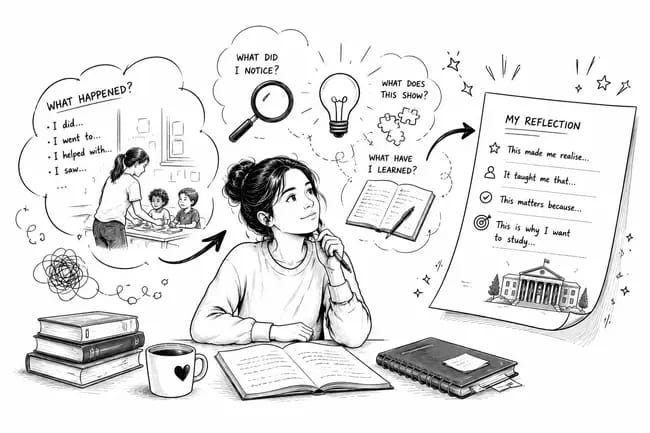
Strong personal statements don't just report what happened. They explain what an experience showed you, how it changed your thinking, and why that insight matters for the course. This guide shows how to move from description to reflection.
Many applicants include relevant experiences in a personal statement but use them weakly. The experience is there, but the writing doesn't show why it matters. Instead of building a case for the course, the paragraph ends up sounding like a record of events.
Strong personal statements handle experience differently. They show what you noticed, what changed in your thinking, and why that development matters for the subject you want to study.
Why description on its own is not enough
Description tells the reader what happened, not what the experience meant, what you understood from it, or how it shaped your interest in the course.
Admissions tutors are less interested in the event itself than in your response to it. Two applicants may have completed the same work experience or attended the same open day, but one will write a list of tasks while the other will show careful thought, intellectual engagement, and a clearer sense of direction. Reflective personal statement writing helps you move from “I did this” to “This is what I learned, and this is why it matters”.
University applications are not asking whether you have been busy. They are asking whether your experiences support your readiness for further study. Reflection is what shows that readiness.
What reflective writing means in a personal statement
In a university application, reflective writing means explaining the significance of an experience rather than only recounting it. You identify what you observed, what questions it raised, what skill or understanding it developed, and how it connects to the subject you want to study.
You don't need to turn every sentence into something dramatic or over-analysed. Good reflection is straightforward. It names a specific experience, draws out a clear insight, and links that insight to your academic motivation or suitability for the course.
Put simply:
- description tells the reader what happened
- reflection shows what changed in your thinking
- application explains why that change matters for your course choice
The difference between describing and reflecting
Descriptive writing often sounds active on the surface, but it leaves the admissions tutor to do the interpretive work. Reflective writing makes your thinking visible.
Consider this simple contrast.
Weak descriptive example
I completed a week of work experience in a primary school, where I helped pupils with reading tasks, observed lessons, and supported the teacher with classroom activities. I enjoyed working with children and found the experience rewarding.
This is clear enough, but it remains general. It tells us what happened and gives a vague reaction. It does not show what the applicant learned about education, themselves, or the demands of the subject.
Stronger reflective example
During a week of work experience in a primary school, I observed how differently pupils responded to the same reading task, which made me think more carefully about the role of adaptation in teaching. Supporting small-group activities showed me that progress often depended less on repeating instructions and more on identifying why a pupil was struggling in the first place. That experience strengthened my interest in education because it showed me how closely effective teaching depends on observation, responsiveness, and subject knowledge.
The second version still mentions the same experience, but it does more. It identifies a specific observation, extracts a point of learning, and connects that learning to a broader understanding of the subject.
A simple structure for reflective paragraphs
If you find reflective writing difficult, use a simple sequence:
- Name the experience briefly.
- Identify what you noticed, questioned, or realised.
- Explain what that taught you.
- Link it to the course or to a quality needed for studying it.
The same structure appears in our guide to Personal Statement Paragraph Structure. The key is to keep the experience short and give more space to the meaning. The reflective part should take up more room than the description.
For example, if you attended an open day, it is not enough to write that you visited a university and listened to talks. Explain which aspect of the course stood out, what it clarified for you, and how it refined your understanding of what the subject involves.
How to move from “what I did” to “what I learned”
A good test is to look at each example in your draft and ask: what would the reader understand about me if I removed the activity itself and kept only the insight? If the answer is “not much”, the paragraph may still be too descriptive.
To deepen an example, ask yourself questions such as:
- What exactly did I notice?
- Did anything challenge my assumptions?
- What skill, idea, or problem became clearer?
- Why is this relevant to the subject?
- How did it influence my thinking about studying this course?
These questions help you move beyond summary. They also prevent a common problem: writing about an experience as if its value were automatic. No activity proves suitability on its own. Its value depends on what you understood from it.
Take this example.
Descriptive version
I read several articles about climate policy and became interested in environmental economics.
The sentence gives the reader very little. Which ideas were important? What did the reading help you understand?
Reflective version
Reading articles on climate policy introduced me to the tension between environmental targets and economic incentives, which made me more interested in how policy decisions are shaped by competing priorities. What especially held my attention was the question of how governments balance long-term sustainability with short-term political and financial pressures. That reading pushed me beyond a general concern for environmental issues and towards a more specific interest in environmental economics.
The reflective version shows an intellectual shift. The experience is not just named; it is interpreted.
Reflection is not the same as emotional reaction
Some applicants assume that reflection means writing in a very personal or emotional way. That is unnecessary. Reflection is about analysis and understanding.
You don't need to say that an experience was inspiring, amazing, or life-changing unless you can explain precisely why. Broad emotional language weakens the point because it replaces evidence with assertion. A calmer, more precise sentence does more work.
For instance:
- weak: The experience was incredibly inspiring and confirmed that this is definitely the perfect course for me.
- stronger: The experience clarified how much I value problem-solving grounded in evidence, which is one reason the course appeals to me.
The second version sounds more measured and more credible. It also avoids promising certainty that the application process cannot guarantee.
How to write about common experiences more effectively
Many applicants worry that their experiences are too ordinary, but ordinary experiences are useful if the reflection is specific. Admissions tutors read many statements containing similar activities. What distinguishes one statement from another is not the activity itself, but the quality of the thinking behind it.
Work experience
Weak descriptive writing often lists tasks. Stronger reflective writing identifies what the experience revealed about the field.
Descriptive:
I shadowed staff in a care home and helped with daily activities.
Reflective:
Shadowing staff in a care home showed me how communication affects care quality in practical, immediate ways. I became more aware that effective support depends not only on routine tasks but also on noticing changes in behaviour, listening carefully, and responding with consistency. That experience made me think more seriously about the relationship between professional responsibility and interpersonal judgement.
Reading and wider research
Weak descriptive writing often mentions a book or article without explaining its effect.
Descriptive:
I read a book about criminal psychology, which I found interesting.
Reflective:
Reading about criminal psychology made me consider the limits of simple explanations for behaviour. What interested me most was the extent to which social context, developmental factors, and individual decision-making can interact rather than operate separately. That complexity is one reason I want to study psychology at degree level, where I can examine behaviour through research rather than assumption.
Competitions and projects
Weak descriptive writing often focuses on participation. Stronger writing explains process, challenge, and learning.
Descriptive:
I took part in a science competition and worked with my team to present our findings.
Reflective:
Taking part in a science competition taught me that presenting findings clearly requires more than understanding the experiment itself. Our group had to decide which results were meaningful, how to explain limitations, and how to justify our conclusions without overstating them. That process improved both my analytical thinking and my awareness of how scientific claims need to be supported.
How to connect experience to course relevance
A reflective paragraph should not end with the experience itself. It should help the reader understand why the example belongs in a statement for that particular course.
You shouldn't force every activity into an obvious claim about career goals. Identify the academic or personal relevance of what you learned. Ask yourself which of these links is most natural:
- it deepened your understanding of the subject
- it developed a skill relevant to degree study
- it challenged or refined your assumptions
- it showed you something important about the demands of the field
- it led you to explore the subject further
Suppose you are applying for history and you volunteered at a local museum. A weak ending would be “This was a valuable experience.” A stronger ending would explain how handling local archival material made you more aware of how historical narratives are constructed from partial evidence, and why that increased your interest in source interpretation.
A practical method for rewriting descriptive sentences
If your draft feels too narrative, do not start from nothing. Rewrite sentence by sentence.
Begin with a descriptive line you have already written, such as:
I volunteered at a local pharmacy and observed how prescriptions were processed.
Then add a second sentence answering one of these questions:
- What did this reveal?
- What did I not understand before?
- What skill or issue became clearer?
For example:
Volunteering at a local pharmacy introduced me to the level of accuracy required in routine professional practice. Observing how prescriptions were checked made me more aware that safe decision-making often depends on careful systems, not just individual knowledge.
Then add a third sentence linking the insight to the course:
That reinforced my interest in pharmacy because it showed how scientific understanding is applied within processes where precision has direct consequences.
This process is easier if you first turn rough notes into usable material, rather than trying to write polished reflection immediately.
Common mistakes that keep writing too descriptive
Several patterns appear repeatedly in weaker drafts.
Listing tasks without interpretation
If you simply list what you did, the paragraph reads like a record rather than an argument for suitability. Trim the list and expand the meaning.
Using vague reactions
Phrases such as “I found it interesting” or “it was very rewarding” are not useless, but they are incomplete. Interesting in what way? Rewarding because of what? Replace broad reactions with precise observations.
Over-explaining the setting
You don't need a long introduction to where the experience happened. One short phrase is enough. Save space for reflection.
Forcing significance
Not every experience has to sound transformative. Sometimes a modest but well-explained insight is more convincing than an exaggerated claim.
Forgetting academic balance
Reflection is strongest when the statement as a whole remains focused on course suitability. If you are including a range of examples, it helps to keep academic and extracurricular material in proportion. Our guide on How to Balance Academic and Extracurricular Content in a Personal Statement explains how to keep that balance clear.
Before and after: fuller examples
Longer comparisons can make the difference clearer.
Example one: medicine
Descriptive version:
I completed work experience in a GP surgery where I observed consultations and saw how doctors interacted with patients. I also learned about the different roles within the practice. This made me want to study medicine.
Reflective version:
Observing consultations in a GP surgery made me more aware of how medical decisions are shaped by both clinical evidence and communication. I was struck by the way doctors had to gather relevant information quickly while also adapting their language to each patient. Seeing the range of roles within the practice also showed me that effective care depends on collaboration rather than isolated expertise. That experience did not simply make medicine seem appealing; it gave me a clearer understanding of the judgement, responsibility, and teamwork the subject demands.
Why it is stronger: the second version identifies specific observations, interprets them, and links them to a more mature understanding of the course.
Example two: engineering
Descriptive version:
I attended a robotics club where we built and tested small machines. I enjoyed working as part of a team and solving problems.
Reflective version:
Through a robotics club, I began to appreciate how design choices that seem minor can affect performance significantly when tested in practice. Building and adjusting our prototype showed me that problem-solving in engineering is often iterative: an idea that appears sound in theory may need repeated refinement under real conditions. That process suited the way I like to work, because it combined analytical thinking with practical testing and revision.
Why it is stronger: the applicant moves from enjoyment to insight and shows an understanding of how engineering works as a discipline.
Example three: English
Descriptive version:
I studied a poem in class and found it interesting to look at different interpretations.
Reflective version:
Studying a poem in class made me more aware that interpretation depends not only on personal response but on close attention to language, structure, and context. What interested me most was how different readings could emerge from the same lines when supported by careful textual evidence. That helped me see English as a subject grounded in analysis rather than impression alone.
Why it is stronger: the paragraph shows a clearer grasp of the academic method of the subject.
How reflection can also show enthusiasm
Applicants sometimes worry that reflective writing will sound too formal or detached. Good reflection makes enthusiasm more convincing because it gives that enthusiasm a reason. Instead of stating that you are passionate, you show sustained interest through thought, reading, observation, and response.
For example, saying that you enjoyed economics tells the reader very little. Explaining that reading about behavioural incentives made you question assumptions about rational decision-making tells the reader far more. It shows interest with substance behind it.
A short editing checklist for reflective writing
When you review your draft, check each experience against these questions:
- Have I kept the description brief?
- Have I explained what I noticed, learned, or understood?
- Have I shown why that matters for the course?
- Have I avoided vague claims such as “interesting” or “rewarding” without explanation?
- Does the paragraph reveal something about how I think, not just what I did?
If the answer to several of these is no, the paragraph probably needs more reflection.
Final thoughts
Strong personal statements rarely depend on extraordinary experiences. They depend on clear thinking, selective detail, and relevant reflection. A short example can be effective if it shows genuine understanding. A long description can still feel empty if it never explains significance.
When you write about experience, aim to do more than record events. Show what you learned, how your thinking developed, and why that development supports your course choice. That is the difference between a statement that describes your activities and one that makes a reasoned case for your application.